

One of our main priorities at Redmond, especially when it comes to hiring, is to hire people who are a great fit, and then get them into the right roles where they can thrive and make their greatest contributions.
We love author Jim Collins’ analogy of seats on a bus: The business is the bus, and the roles are the seats. In order to succeed as a company, you have to get the right people on the bus, and then get those people in the right seats. Only then can the bus take everyone somewhere meaningful!
We find that getting the right people on the bus and in the right seats is a matter of finding people who have the skills for the job and, of equal importance, have a positive impact on the team. When a person has both of those ingredients, we can all synergize and collaborate to create so much more than we ever could alone. This is all a part of being a winning team and enjoying this journey of continuous improvement as a group and individuals.
Enter the (Redmond) Matrix
The Redmond Matrix, shown below, is a tool we use to show why people may or may not be in the right seat (or even the right bus), and whether we’re on the journey of growth and continuous improvement.
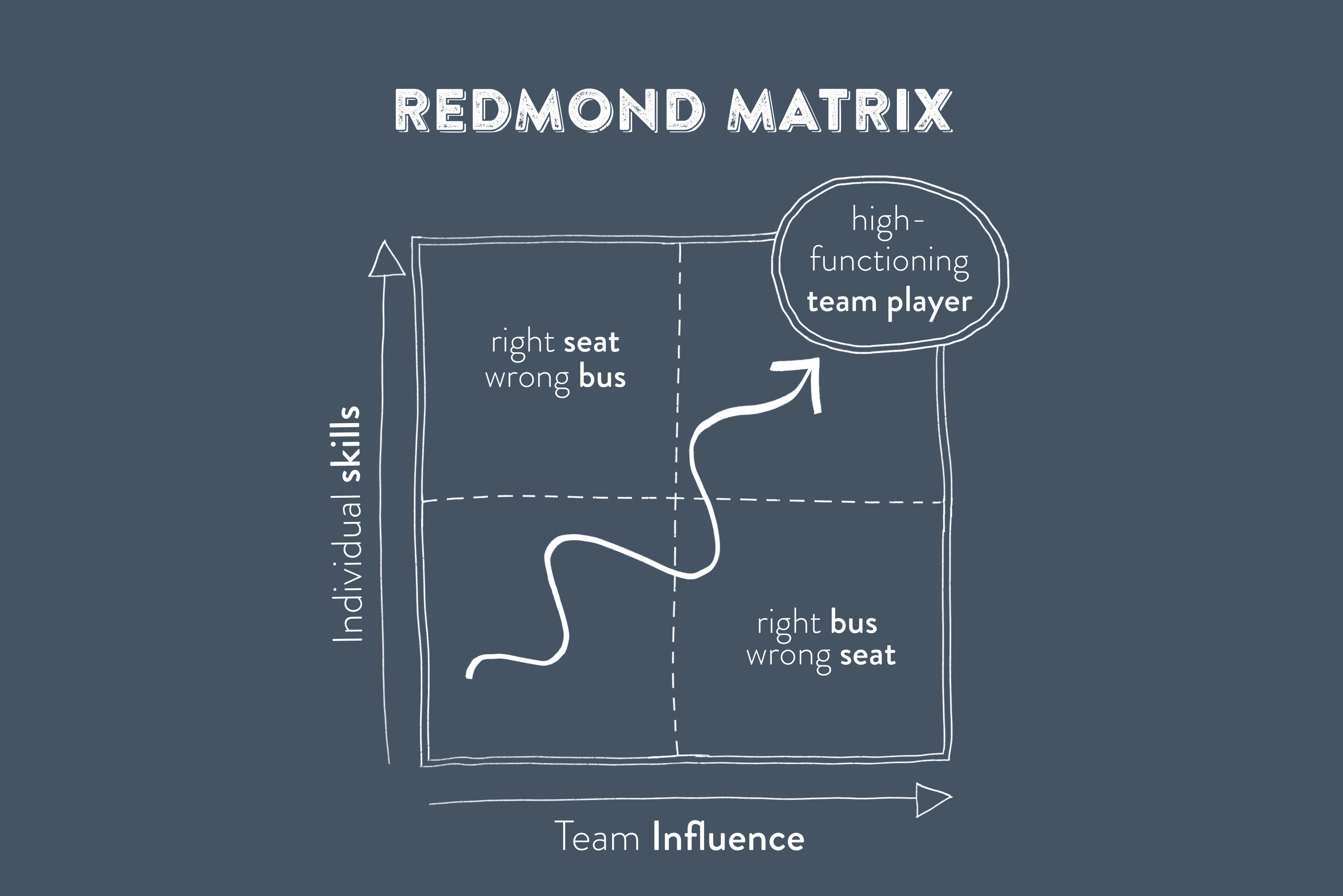
The four boxes represent different combinations of the two traits that are key for success at Redmond: individual skills and team influence.
The squiggly arrow represents the path we all want to be on: continually developing our job skills AND doing our best to have a positive impact on the team as a whole.
It’s totally normal to move around this matrix, or to be on the edges of a box. However, it’s a slow, gradual transition from one area to another. Growth is incremental!
We don’t need to say much about the lower box on the left, because if someone doesn’t have the job skills or team skills, they aren’t a good fit, so let’s talk in a bit more detail about what the the upper left and lower right boxes look like.
Upper Left Box: Highly skilled, but negative team influence
If an associate is in this box, they’re good at what they do, but might not have great people skills or might struggle with our culture of continuous improvement and collaboration.
The person may simply lack people skills or be unaware of how they are affecting the team. In that case, oftentimes it just takes some kind, clear guidance to help them develop team skills.
Sometimes, the associate is simply on the wrong bus, which is totally fine! Redmond is not for everyone. If we need to part ways, we do this as kindly as possible and do our best to set them up to find success somewhere else. We want everyone to thrive, even if that’s with a different company.
Are you in the upper left box?
- I have a lot of experience in this position.
- I’m very educated in this area of work.
- I feel like I care more than most people about my job
- I have a lot of good ideas, and I’m not afraid to promote them.
- I’m very honest. I speak my mind and don’t mind if it’s hard for others to hear.
But…
- I get annoyed when others slack or work too slowly (sometimes it’s easier to just do everything myself).
- I often feel underpaid and underappreciated.
- Sometimes I think I’m the only one that can do it right.
- I don’t ask for or accept help.
- I don't see value in being myself at work, being vulnerable, and getting to know my team members on a deeper level at team activities and culture meetings.
If someone is in the upper left box, sometimes they find they’re happier and find their place in the team with some mentoring and working on team player skills. (The Ideal Team Player by Patrick Lencioni is a great resource for this!)
Lower Right Box: Positive team influence, but low on individual skills

Someone in this box may enjoy their team and the company, and get along really well with others, but have a hard time in their actual role. Or, they might not have the skills or knowledge to do the job well.
And even though their team may like them as a person, there might be some frustration if they aren’t doing their job well.
Are you in the lower right box?
- I really like the people I work with.
- I bring good energy to the group.
- People generally enjoy working with me.
- I listen and collaborate well with others.
- I enjoy the Redmond culture and look forward to culture meetings and team activities.
But…
- I don’t really like what I actually do for work
- I don’t feel like I’m good at what I do.
- I have a hard time feeling motivated, focused, and productive.
- I don’t feel very creative at work, or that I’m contributing much.
- My work doesn’t come easily to me, and I often feel like I frustrate people from a lack of ability or aptitude at work. (It can be hard to admit, but this is important for finding where you can make your best contribution!)
It’s usually easier to get out of this box than the upper left box because an associate can often shift seats or learn new skills if they have talent and interest but simply lack knowledge. A lot of the time, this just requires some training and adjustments!
The Squiggly Arrow Path: Continuous Improvement

This is the journey we ALL want to be on, where we’re constantly growing and improving our job skills and how we work with our teams.
And it doesn’t matter where you start. The first step on this path is to decide you want to take the journey.
Are you on the Squiggly Arrow path?
- I seek other perspectives and do my best to understand them.
- I speak up not to be right, but because I care about the work. I know I’m usually partially right and partially wrong.
- I really care about my impact and contribution. I am not primarily motivated by what is in it for me, but rather by how I can help others.
- I am focused, committed, and passionate about my work, and it’s a big part of what fills my cup.
- I am always reflecting on and discussing what to learn from my experiences so that I learn the right lessons (and not the wrong ones).
- I try to bring uplifting, positive energy to my team and interactions.
- I’m on a constant journey to know myself better and where I can make my greatest contribution.
- I engage in my team and company meetings because I know that doing so directly affects my ability to be helpful and ultimately elevate the human experience.
How to get on the Squiggly Arrow path:
This has a lot to do with being on the right bus and in the right seat, but it’s also about engaging with our culture. Commit to your own learning, growth, and development, because that’s what Redmond’s all about! Get excited about learning about yourself and others.
There’s always room for improvement, but the important thing is to be moving in a generally good direction. This path isn’t born of a desire to prove yourself, but the drive to grow and improve as a person, to make your greatest contribution, and to be part of a winning team for the fulfillment of it, not the accolades.
Because becoming who you are is the most fulfilling work you will ever do.
